
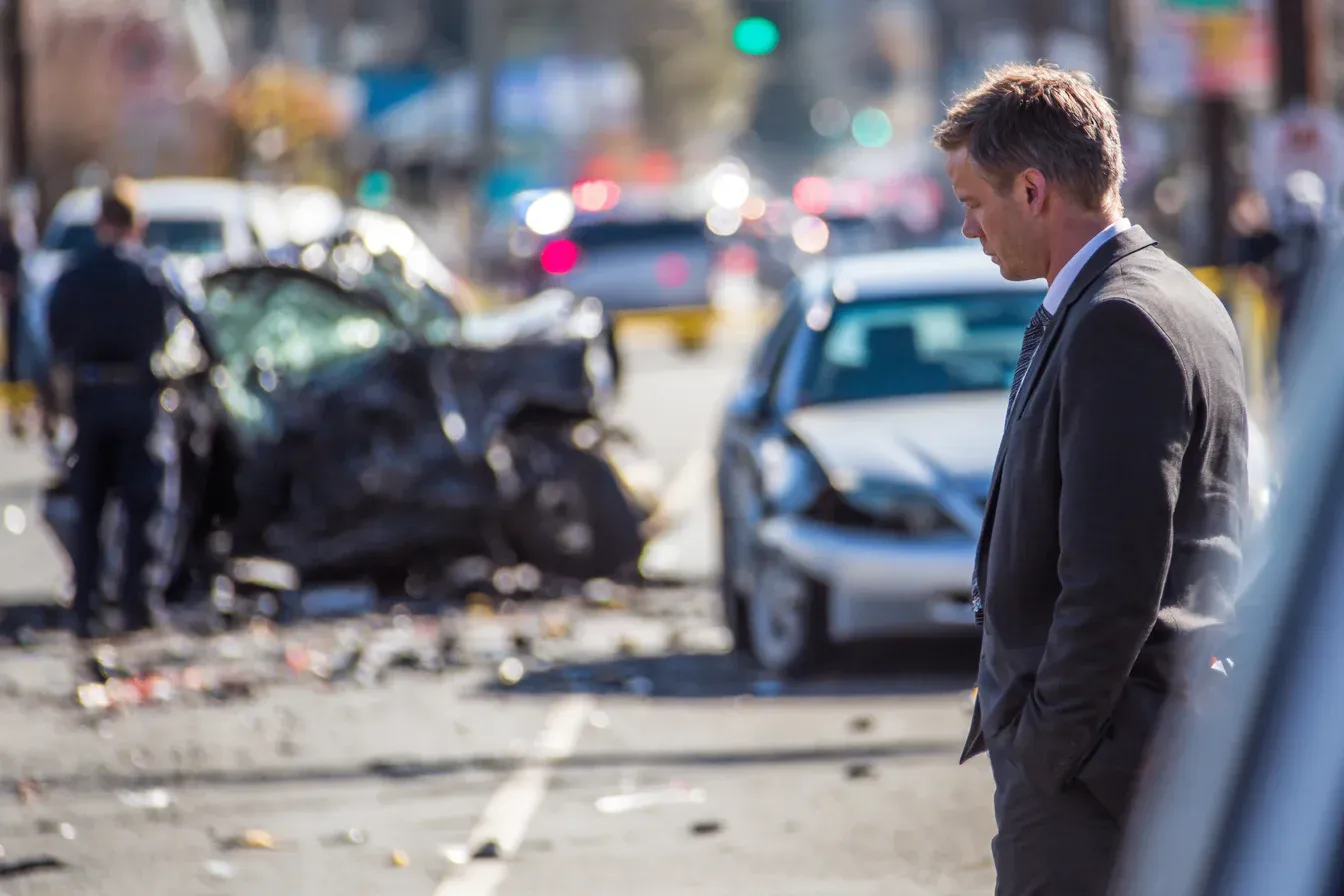
How Fault Is Determined in Nevada
FREE CASE EVALUATIONBy Your Side
Securing Your future
No Fee Until We Win
Las Vegas Personal Injury Lawyers
In Nevada, fault is determined by proving which driver was negligent, using evidence like police reports, photos, and witness statements. Insurance adjusters assign fault percentages first, and a judge or jury decides if the case goes to trial. Under Nevada’s comparative negligence law (NRS 41.141), your compensation drops by your share of fault and is barred if you are more than 50% responsible.
After a car accident in Las Vegas, one question shapes everything that follows: who caused the crash? A collision at a busy intersection like Flamingo and Decatur or a sudden lane change on the I-15 can happen in seconds, but the fight over fault can last for months. While you deal with medical bills and time away from work, the other driver’s insurance company is already building its version of what happened.
The challenge is that fault is rarely all or nothing in Nevada. Insurers often assign you a share of the blame, sometimes with little explanation, because every percentage point they assign reduces what they owe you. Without understanding how fault is decided, many drivers accept a fault split that costs them thousands of dollars.
In this article, you will discover how fault is determined in Nevada, what evidence proves it, how shared fault affects your compensation, and how an auto accident lawyer can help you protect your claim.
How Is Fault Proven in Nevada?
Nevada is an at-fault state. This means the person who caused your accident is legally responsible for paying your damages, through their insurance or out of their own pocket.
Fault is proven using the standard of negligence. Negligence means someone failed to act with reasonable care and that failure caused your injury. To win a negligence claim, you must prove all four of these elements:
- Duty: The other party had a legal obligation to act with reasonable care toward you.
- Breach: They violated that obligation through a specific act or failure to act.
- Causation: Their failure directly caused your injuries.
- Damages: You suffered real, measurable harm as a result.
Once fault is established, Nevada’s modified comparative negligence rule under NRS 41.141 determines how much you can actually recover.
Who Decides Fault and When
Three different parties weigh in on fault, and only one of their decisions is legally binding.
- The responding police officer documents the scene and writes a crash report that becomes part of the official record.
- The insurance adjuster reviews evidence and assigns fault percentages. Their job is to pay you as little as possible, not to protect you.
- A judge or jury issues the only determination that is legally enforceable.
An adjuster’s fault finding feels official, but it is simply an opening position. Never accept it as final. It can be challenged with the right evidence.
What Evidence Proves Fault in Nevada?
Fault is a conclusion built from evidence. The quality of that evidence almost always decides the outcome of your claim, and it can disappear within hours of an accident.
Police Report and 911 Records
The official police report captures the officer’s scene narrative, a crash diagram, witness contact information, and any citations issued. It creates the foundational record that adjusters and juries rely on, and any citation issued can strengthen the case that the other driver was negligent.
Scene Photos, Video, and Surveillance
Photographs and video give objective proof of vehicle positions, damage, and road conditions. We immediately search for footage from dash cams, business cameras, and Ring doorbells, because this evidence is routinely deleted within days.
Vehicle Damage, EDR, and Airbag Data
The location and pattern of damage helps establish how the crash unfolded. We also retrieve data from the vehicle’s Event Data Recorder (EDR), the “black box,” which records speed, braking, and steering in the seconds before impact.
Witness Statements and 911 Callers
Independent witnesses have no stake in the outcome, making their accounts highly credible. Their statements and 911 call audio captured moments after the crash can confirm or directly contradict what the at-fault driver claims.
Road Rules and Citations
When a driver receives a traffic citation, it creates strong evidence of breach. A ticket for following too closely under NRS 484B.127, for example, is powerful proof of negligence in your personal injury claim.
Medical Records and Expert Testimony
Your medical records connect your injuries directly to the accident, satisfying the causation and damages elements of your claim. In disputed liability cases, we bring in accident reconstruction experts who use physics and engineering to establish exactly how the crash occurred.
In one case we handled, a driver who hit our client on a bicycle claimed he had stopped at a three-way stop, looked both ways, and rolled forward at 5 to 10 miles an hour. Our accident reconstruction expert showed that our client could only have landed 15 to 20 feet away if the car was traveling about 35 miles an hour, the speed limit on that street. The jury found the driver 100% at fault and returned a $536,000 verdict, after the insurance company had offered only $25,000.
“By proving the driver’s own version of events wasn’t scientifically possible, I was able to prove he had to have been distracted.” – Adrian Karimi
Does Comparative Negligence Reduce Your Claim?
Nevada law reduces your recovery by your percentage of fault, but you can still collect as long as your share of fault is 50% or less. This rule applies whether your case involves a car crash, a slip and fall, or any other personal injury claim.
If your share of fault is more than 50%, you cannot recover damages. That is the hard cutoff under NRS 41.141.
| Your Share of Fault | What You Recover |
| 0% | 100% of damages |
| 25% | 75% of damages |
| 50% | 50% of damages |
| 51% or more | Nothing |
In practice, if your damages are $100,000 and you are found 20% at fault, you recover $80,000.
Insurance companies know this math cold. Every percentage point they push onto you is money they keep, and that is their strategy, not a coincidence.
In one case we handled, a driver reversed quickly out of a parking space without making sure it was safe and hit our client hard. The insurance company assigned our client 20% of the fault without fully explaining why. Whatever percentage an insurer assigns is the discount it takes on what it pays, which is why we challenge those numbers with evidence instead of accepting them.
“What insurance companies like to do is find a way, even if they’re at fault, to assign what’s called comparative fault, in order to pay less.” – Adrian Karimi
How Fault Works by Case Type
The four elements of negligence apply to every injury case in Nevada, but the evidence used to prove fault changes depending on the situation.
- Auto and motorcycle collisions: The rear driver is usually found at fault in a rear-end crash, but Nevada does not automatically presume it. That finding can be challenged if the front driver changed lanes without warning or had non-functioning brake lights. For intersection crashes, fault usually turns on who had the right-of-way.
- Truck and commercial vehicle crashes: Fault can extend beyond the driver to the trucking company, maintenance contractors, and cargo loaders. Federal Electronic Logging Device (ELD) records and hours-of-service logs are critical evidence.
- Slip and fall and premises liability: Fault requires showing the property owner knew, or should have known, about a dangerous condition and failed to fix it or warn you. This knowledge requirement is called “notice.”
- Medical malpractice: Fault requires expert testimony proving the doctor or hospital violated the accepted standard of care for your condition.
- Product liability: Nevada applies strict liability to defective products. You do not have to prove the manufacturer was careless, only that the product was defective and caused your injury.
In another case, a driver turning left from a small street onto a main road collided with our client and then claimed our client had changed lanes right before impact. We showed that our client had the right of way no matter which lane he was in, and an expert proved from the point of impact and where the cars came to rest that no lane change happened.
Common Fault Arguments from Insurers and How We Answer Them
Ramzy Ladah started his career defending Nevada’s largest insurance companies. He knows every argument they make on fault, and today we use that insider knowledge to fight those tactics on your behalf.
Here are the arguments you will hear most often:
- “The damage was too minor to cause injury.” Modern bumpers absorb impact while channeling that force directly to the occupants inside. We use medical imaging to document the real harm done to you.
- “You waited too long to see a doctor.” Adrenaline masks pain in the immediate aftermath of a crash. Symptoms from whiplash and traumatic brain injuries are frequently delayed by days.
- “You had a pre-existing condition.” Nevada law requires defendants to take victims as they find them. They are responsible for making a prior condition worse.
- “You admitted fault at the scene.” A stressed apology is not a legal admission of liability. Physical evidence, not a panicked phrase, establishes fault.
We build every case to go to trial, and that posture forces insurers to take fault seriously. It is how we secured a $15 million jury verdict in a reckless driving case and an $11 million head injury settlement.
“Insurance companies pretend to be your friend. But they’re only trying to set you up to fail.” – Adrian Karimi
What to Do after a Crash or Injury in Nevada
Evidence disappears fast. What you do in the first 48 hours defines the strength of your fault case.
Step 1: Call 911 and Get Medical Care
This creates the two most important documents in your claim: the police report and the initial medical record linking your injuries to the incident.
“It’s a sword in the shield that the insurance company does. They try to delay and prevent people from going to see doctors, and then use it against them when they don’t.” – Adrian Karimi
Step 2: Document the Scene
Take wide-angle photos of all vehicles, skid marks, debris, and traffic signals before anything is moved.
Step 3: Preserve Nearby Video
Identify businesses and homes with cameras near the scene right away. Surveillance footage is often overwritten quickly, and casino and resort cameras on the Las Vegas Strip are commonly subject to strict retention schedules.
Step 4: Report without Giving a Recorded Statement
Notify your own insurer as required by your policy. Do not give a recorded statement to the other side’s adjuster before speaking to an attorney.
Step 5: Call Ladah Injury & Car Accident Lawyers Las Vegas
We send evidence preservation letters and launch our own fault investigation, often before the insurance adjuster finishes theirs.
How Long Do You Have to File in Nevada?
The statute of limitations, the legal deadline to file a lawsuit, is two years from the date of injury for personal injury claims under NRS 11.190(4)(e). Property damage claims carry a three-year deadline, while wrongful death claims have a two-year deadline.
Claims against a government entity also require a separate formal notice of claim under NRS 41.036, but that deadline is the same two years, not shorter. Missing your deadline means the court will almost certainly dismiss your case, no matter how strong your evidence is. Acting early protects your rights and the evidence that supports your claim.
What Damages Can You Recover despite Shared Fault?
If your fault is 50% or less, you can pursue full compensation, reduced only by your share of blame.
Your damages fall into three categories:
- Economic damages: Medical bills, future treatment costs, lost wages, lost earning capacity, and property damage, all calculated from actual financial records.
- Non-economic damages: Pain and suffering, emotional distress, and the loss of your ability to enjoy daily life. There is no cap on these in standard Nevada personal injury claims.
- Punitive damages: Reserved for extreme recklessness or intentional misconduct, these punish the defendant beyond compensating you.
Injured in Nevada? Talk to Us Today
We have recovered over $400 million for injured clients, including a $70.6 million wrongful death judgment and a $10 million trucking verdict. When insurance companies know we are prepared to go to verdict, they think twice about inflating your fault percentage.
We have offices in Downtown Las Vegas, North Las Vegas, and Spring Valley. You pay nothing unless we win, and you have direct cell phone access to your attorney from day one.
“Ramzy is just very thorough, and he explains things very well. He was in contact with me consistently. I felt like I knew what was going on at all times. And the way he prepared me made me feel very, confident in both my ability to testify and also in his strategy. If you are hurt, if you’ve been in a car accident, if you have been injured in some way, I would recommend Ladah Law.” – A. Wilson
Frequently Asked Questions
Is Nevada an At-Fault or No-Fault State?
Nevada is an at-fault state, meaning the driver or party responsible for causing the accident is legally required to pay for the resulting injuries and property damage.
Does a Police Report Determine Fault in Nevada?
No. A police report is strong evidence, but it does not legally decide fault. Both insurance adjusters and, if the case goes to trial, a jury make their own independent determinations.
Is the Rear Driver Always at Fault in a Nevada Rear-End Collision?
Usually, but not always. Nevada does not automatically presume the rear driver is at fault, and fault can shift if the front driver changed lanes suddenly, braked without cause, or had non-functioning brake lights.
How Is Fault Divided in a Multi-Car Chain-Reaction Crash?
Fault is assigned to each driver as a percentage, with the driver who caused the initial collision typically bearing the most responsibility, though others can share fault based on their own actions.
Can You Recover Damages If You Were Partly at Fault in a Slip and Fall?
Yes, as long as your share of fault is 50% or less. Your total recovery is simply reduced by your assigned fault percentage.
What Does It Cost to Hire Ladah Injury & Car Accident Lawyers Las Vegas?
Nothing upfront. Every case is handled on a contingency-fee basis, meaning you pay no attorney fees unless we recover money for you.
Contact Ladah Injury & Car Accident Lawyers Las Vegas
Call us at (702) 252-0055 for a free consultation. We serve injured clients from three offices across the Las Vegas Valley: Downtown Las Vegas, North Las Vegas, and Spring Valley.
By Your Side, Securing Your Future.
Request Free consultation
"*" indicates required fields
Experience the difference with ladah law
![quotes]() D. Martinez
“Hi, my name is Dina Martinez. My lawyer’s name is Ramzy Ladah. He is the best lawyer I know. I had another lawyer before I got in this car accident but my lawyer didn’t work the way I wanted. I was so scared because these big, old companies with their big lawyers – you’re scared because you don’t know what is the best way of dealing with them. Ramzy Ladah does exactly what I want. The way he fights in court for me was really good. It was like my family member fighting for a family member. It wasn’t like a lawyer fighting for just somebody, like other lawyers do. I recommend Ramzy Ladah because he does a really, really good job. With these big old companies, you have to deal with when you have a car accident, its kind of impossible for a regular, normal person. So you need a lawyer – that’s Ramzy Ladah. We won and we got a lot of money and I’m so happy about it.”
CALL OR TEXT 24 HOURS FOR A FREE CONSULTATION: 702.252.0055
By Your Side
Securing Your future
No Fee Until We Win
Las Vegas Personal Injury Lawyers
LADAH results
LADAH love
related blog posts
In Las Vegas, car accidents can be complex and involve numerous issues such as fault, coverage of insurance costs, and financial compensation. An attorney experienced in these matters is the best to handle your claim – investigating the accident situation thoroughly to establish liability on behalf of an at-fault driver due to distracted driving or any other traffic rule violations. This lawyer will help you obtain a fair settlement for damages stemming from injuries connected with that incident.
The said professional also supports their client through all stages involved with settling claims against responsible parties and getting them compensated fairly. Ensuring full payment according to what would rightfully cover their losses after a vehicular crash in Nevada’s main city area: Las Vegas.
Car Accidents
The 5 Most Dangerous Intersections in Las Vegas
The city of Las Vegas sees more than its fair share of serious auto accidents. Indeed, the Allstate Best Driver’s Report ranks Vegas 127th of 200 cities in its annual weather-adjusted crash rankings. According to their data, Las Vegas drivers...
read moreCar Accidents
10 Key Driving Skills to Teach New Drivers
Teach new drivers essential skills like defensive driving, proper use of signals, maintaining safe distances, obeying traffic laws, and handling distractions. Instilling habits like checking mirrors, staying calm under pressure, and navigating heavy traffic builds confidence and ensures safety on...
read moreCar Accidents
Avoiding Drowsy Driving Accidents in Las Vegas
Similar to other major urban areas, driving in Las Vegas can put you at risk of injuries in a serious car accident. In particular, when you get behind the wheel of a car after failing to get enough sleep the...
read moreCar Accidents
5 Ways Proper Vehicle Maintenance Is A Safety Measure Against Being In An Accident
One minute you are driving down the road, running errands or headed to work or school, and the next you are involved in a car accident in Las Vegas, resulting in serious injuries and property damage. It happens all the...
read moreCar Accidents
Essential Checklist for Your Annual Car Inspection
It is just as important to be a safe driver, as it is to drive a vehicle that is in safe condition. A yearly car safety inspection can ensure that your vehicle is in proper working condition and is at...
read moreLas Vegas Personal Injury Lawyers call FOR A FREE CONSULTATION: 702.252.0055