
I-15 through Nevada has earned its ‘Highway to Hell’ reputation from a relentless string of catastrophic desert highway crashes. Extreme heat, exhausted truckers, and unfamiliar tourist drivers collide across more than 120 miles connecting Las Vegas to Southern California and Utah. Crash hotspots cluster near Primm, the Spaghetti Bowl, and the Virgin River Gorge, and Nevada law gives you two years to file a claim.
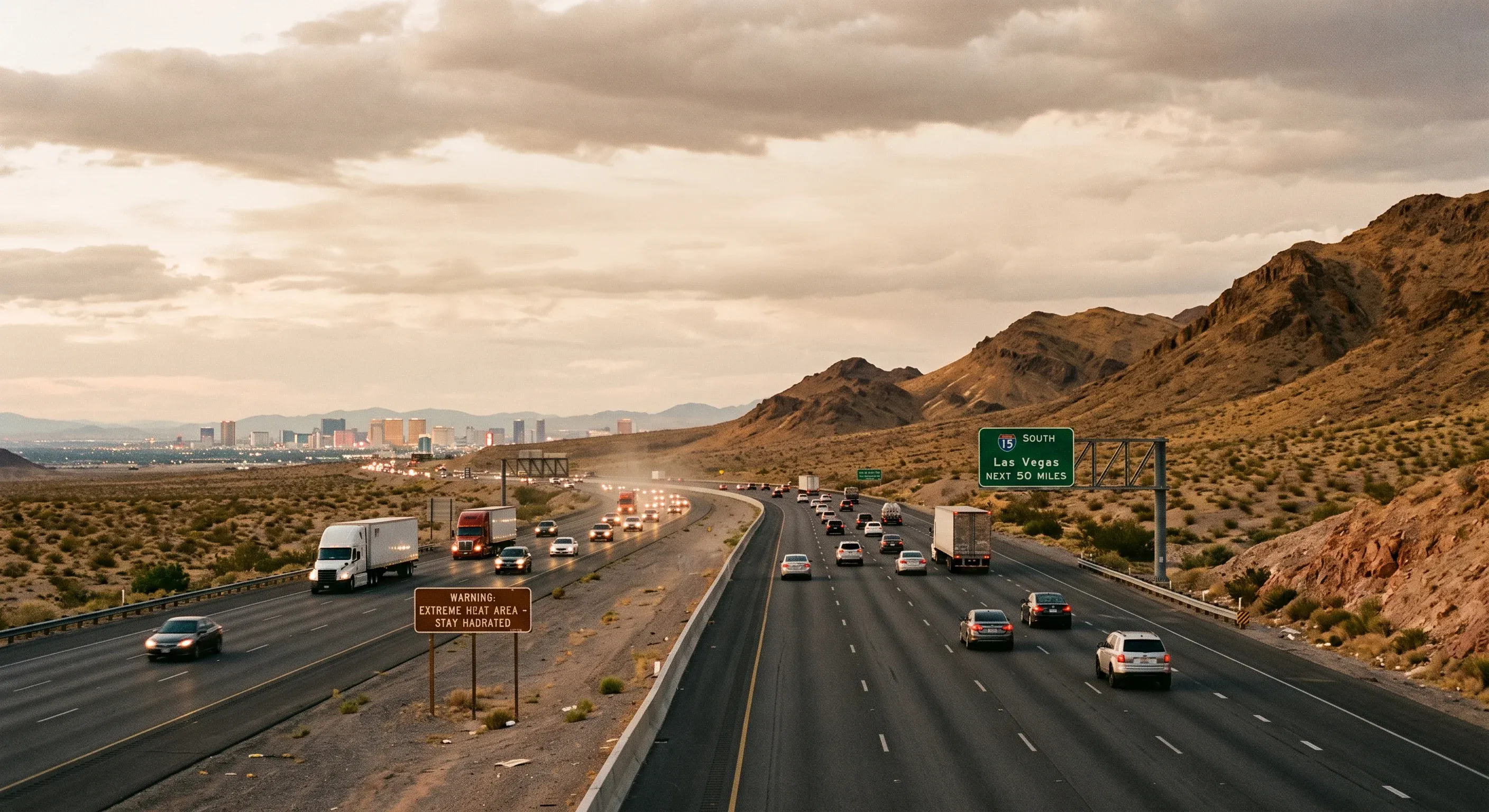
A crash on I-15 can leave you with serious injuries, a totaled vehicle, and mounting medical bills before you even understand what happened. Drivers heading home from a Las Vegas weekend near Primm and Sloan, tourists merging through the Spaghetti Bowl, and truckers descending into the Virgin River Gorge near Mesquite all face conditions that turn ordinary mistakes into life-changing collisions. Insurance adjusters move fast after these crashes, often calling before you have finished your first round of treatment.
The problem gets harder because I-15 crashes rarely involve a single cause or a single at-fault party. Speeding, drowsy driving, tire blowouts from desert heat, and commercial trucking violations often overlap in the same collision, and insurers use that complexity to shift blame and minimize what they pay. Nevada’s modified comparative negligence rule means a well-documented dispute over fault can cut your recovery to nothing if you are found 51% or more responsible.
Understanding how I-15 crashes happen and how Nevada law treats them puts you in a far stronger position to protect your claim. In this article, you will discover why I-15 through Nevada is so dangerous, where the deadliest crash hotspots are, what Nevada law means for your case, and how a Las Vegas I-15 accident attorney can help you pursue full compensation.
What Makes I-15 Through Nevada So Dangerous?
Interstate 15 is the main highway connecting Las Vegas to Southern California and Utah, running more than 120 miles across Nevada desert. It carries millions of tourists and long-haul truckers every year, and it has earned a brutal reputation for fatal crashes.
The “Highway to Hell” nickname is not exaggeration. It is the product of unfamiliar tourist drivers, extreme desert heat, and heavy commercial truck traffic, all sharing the same unforgiving road.
Related: The Most Dangerous Intersections in Las Vegas
Where Are the Deadliest Crash Hotspots on I-15?
Crashes do not happen evenly across I-15. They concentrate in predictable locations, and knowing where they are matters.
Primm to Sloan
This stretch near the California-Nevada border is where crash risk spikes fast. Drivers heading home after a Las Vegas weekend are fatigued, and the wide-open road invites dangerous speeds.
I-15 and the Spaghetti Bowl
The interchange connecting I-15 with US-95 in Downtown Las Vegas, known locally as the Spaghetti Bowl, is a tangle of merging lanes under constant pressure. Unfamiliar drivers make last-second exits, and rear-end collisions are a constant result.
The Strip Corridor: Tropicana to Sahara
Tourist confusion peaks along this stretch. Exits come fast, braking is sudden, and the sheer volume of unfamiliar drivers makes every mile unpredictable.
North Las Vegas Apex to Speedway
Speeds climb quickly once the city thins out, and commercial truck volume near the Apex Industrial Park adds constant hazard. Event days at Las Vegas Motor Speedway make it significantly worse.
Mesquite to the Arizona Border
The approach to the Virgin River Gorge is steep and winding. Large trucks struggle with braking control on the descent, and the sudden change in terrain catches unprepared drivers off guard.
One pattern we consistently see in I-15 crash claims is that the location of the collision often drives how the insurance company argues fault. A rear-end crash we investigate near the Spaghetti Bowl gets blamed on the driver behind for following too closely, while a rollover near the Virgin River Gorge outside Mesquite gets blamed on the victim for driving too fast on a grade every local driver knows is steep. In our experience handling I-15 claims that touch Primm, Sloan, and the Strip corridor, insurers lean on generic accident reconstruction reports instead of the specific road conditions at each hotspot, and that gap is often where we find the leverage to change the outcome of a claim.
When Is I-15 Most Dangerous?
When you drive on I-15 matters as much as where you drive. These windows carry the highest crash risk:
- Friday afternoons: Westbound lanes fill with weekend travelers, triggering congestion and aggressive passing.
- Sunday afternoons: Eastbound traffic swells with return trips, filled with fatigued and sometimes impaired drivers.
- Holiday weekends: Volume spikes sharply, turning normal driving into stop-and-go gridlock that breeds rear-end crashes.
- Midnight to 5 AM: Peak territory for drowsy driving, when tourists and truckers push past their limits.
- Summer afternoons: Extreme pavement heat causes tire blowouts, especially on older or underinflated tires.
Related: SR-582: Why This Stretch Has Nevada’s Highest Fatal Accident Rate
What Causes Most I-15 Accidents in Nevada?
Speeding and Aggressive Passing
The long, open desert stretches invite dangerous speeds. A driver going well over the limit has almost no time to react when something goes wrong.
Impaired Driving
Nevada law sets the legal BAC limit at 0.08% for most drivers and 0.04% for commercial truck drivers. I-15 is the primary exit from a 24-hour city, which means impaired drivers are on this road around the clock.
Drowsy Driving
Fatigue impairs judgment in ways that rival drunk driving. Flat, unchanging desert can trigger highway hypnosis, where a driver mentally checks out behind the wheel without realizing it.
Semi-Truck Blind Spots
Large trucks have blind spots on all four sides called no-zones. If you are driving in those zones, the truck driver cannot see you, and a routine lane change becomes catastrophic.
Tire Blowouts
Desert pavement reaches extreme temperatures in summer. Underinflated or worn tires can fail without warning at highway speeds, sending vehicles into rollovers or multi-car crashes.
What Nevada Laws Affect Your I-15 Crash Claim?
Modified Comparative Negligence
Nevada uses a modified comparative negligence rule. This means your compensation is reduced by your share of fault, and if you are found 51% or more responsible, you recover nothing. Insurance companies use this rule aggressively to minimize what they owe you.
Statute of Limitations
The statute of limitations is your legal deadline to file a lawsuit. In Nevada, you generally have two years to file a claim from the date of your accident to pursue a personal injury claim. Miss that window and you permanently lose your right to sue.
Minimum Insurance and UM/UIM Coverage
Nevada requires drivers to carry at least $25,000 per person liability coverage, up to $50,000 per accident, plus $20,000 in property damage coverage. Because I-15 draws so many underinsured out-of-state drivers, your own Uninsured/Underinsured Motorist (UM/UIM) coverage, a policy that pays when the at-fault driver cannot, is critical protection.
The Handheld Phone Ban
Nevada law prohibits handheld phone use while driving. If the driver who hit you was on their phone at the time, that violation is direct evidence of negligence in your claim.
A tactic we see repeatedly from adjusters handling I-15 claims out of Clark County is assigning as much comparative fault to the victim as the evidence will possibly allow, since even a few percentage points can meaningfully reduce what they owe under Nevada’s modified comparative negligence rule.
What we see across the I-15 claims we handle for crashes near Apex Industrial Park and North Las Vegas is that commercial carriers move quickly to send their own investigators to the scene, often before our client has been discharged from the hospital, and that head start is exactly why we push to preserve dashcam footage, ELD data, and phone records as early as possible.
What to Do After an I-15 Crash
The steps you take immediately after a crash can determine the outcome of your case. Here is what matters most:
- Call 911 and get medical care: Get checked out right away, even if you feel fine, many serious injuries do not produce symptoms immediately.
- Document the scene: Photograph the vehicles, road conditions, skid marks, debris, and any visible injuries before anything is moved.
- Exchange information without admitting fault: Get the other driver’s insurance details and contact information. Never say “I’m sorry” or suggest the crash was your fault, those words can be used against you.
- Preserve dashcam footage and truck data: Save any dashcam video immediately. For truck accidents, your attorney must send a preservation letter right away to secure the truck’s Electronic Logging Device (ELD), a black-box system that records speed, braking, and hours driven.
- Decline a recorded statement to the at-fault driver’s insurer: You are not required to give one. Politely decline and speak to an attorney first.
Who Can Be Held Liable for an I-15 Accident?
Liability on I-15 rarely stops with the driver who hit you. Identifying every responsible party often unlocks additional insurance coverage and a larger recovery for you.
Negligent Drivers
The at-fault driver is the starting point, whether they were speeding, impaired, or distracted.
Trucking Companies
If a truck driver caused your crash, their employer can also be liable for negligent hiring, pushing drivers past federal safety limits, or failing to maintain the vehicle properly.
Road Contractors
Construction companies that leave unsafe conditions, unmarked lane shifts, missing warning signs, debris in the road, can share liability for the crashes their negligence causes.
Government Entities
If a road defect or signal failure contributed to your crash, a government entity may be responsible. These claims require you to file a formal written notice of claim with the government agency, and while Nevada gives you the same two-year window as a standard injury claim, missing that notice requirement can still bar your case, so acting fast is critical.
Vehicle Manufacturers
If a defective part caused the crash, faulty brakes, a blown tire, or a steering failure, the manufacturer can be held liable under product liability law.
Across the I-15 liability claims we’ve worked through in Clark County, the issue that surfaces most often is that more than one party shares responsibility for the crash, yet only the driver’s minimum policy gets offered upfront. A multi-vehicle pileup near the Strip corridor or a jackknifed rig blocking lanes near Las Vegas Motor Speedway on a race weekend can implicate a trucking company, a negligent contractor, or even the manufacturer of a failed part, and identifying every liable party is often what separates a minimum policy payout from a recovery that actually covers a client’s future care.
What Compensation Can You Recover After an I-15 Crash?
Nevada law allows you to pursue two categories of damages. Economic damages cover direct financial losses. Non-economic damages cover personal harm, pain, emotional suffering, and reduced quality of life. We fight for every dollar in both.
- Medical bills and future care: Every dollar of treatment, from your first ER visit through long-term rehabilitation.
- Lost income and earning capacity: Wages already lost plus the long-term impact on your ability to earn.
- Pain and suffering: Compensation for physical pain, emotional distress, and the ways this injury has changed your life.
- Property damage: The full cost to repair or replace your vehicle.
- Punitive damages: When a crash involves extreme recklessness, like a drunk driver, a jury can award additional damages to punish that conduct.
“I was rear-ended when I was pregnant and had to have multiple surgeries. I’m beyond grateful for everybody and I would definitely recommend Ramzy Ladah and his law firm to anyone who’s looking for a great lawyer.” – J.L.
How Ladah Injury & Car Accident Lawyers Las Vegas Handles I-15 Cases
Insurance companies have one goal: pay you as little as possible. They have corporate legal teams, unlimited investigation budgets, and years of experience doing exactly that. We built our firm to counter every one of those advantages.
Our founder, Ramzy Ladah, started his career defending those same insurance companies at one of Nevada’s largest defense firms. He knows their playbook from the inside, every tactic, every pressure point, every reason they will use to undervalue your claim. That knowledge now works exclusively for injury victims.
Ramzy is certified as a personal injury specialist by the Nevada State Bar and has been recognized for his litigation work.
We do not take the first offer. We prepare every case for trial, and our willingness to go all the way to a jury verdict is exactly what forces insurers to pay full value. It is how we secured significant verdicts and substantial recoveries for our clients.
You pay nothing unless we win. From day one, you get direct cell phone access to your attorney and 24/7 availability throughout your case.
“Ramzy is just very thorough, and he explains things very well. He was in contact with me consistently. I felt like I knew what was going on at all times. And the way he prepared me made me feel very confident in both my ability to testify and also in his strategy. If you are hurt, if you’ve been in a car accident, if you have been injured in some way, I would recommend Ladah Law.” – A. Wilson
Injured on I-15? Get Legal Help Now
The insurance company is already building its case against you. You need someone who knows exactly how they operate.
Contact Ladah Injury & Car Accident Lawyers Las Vegas for a free consultation. With offices in Downtown Las Vegas, North Las Vegas, and Spring Valley, we are available around the clock and ready to fight for you today.
Frequently Asked Questions
Is I-15 One of the Deadliest Highways in Nevada?
Yes. I-15 consistently ranks among Nevada’s most dangerous roads because of its high tourist traffic volume, heavy commercial truck presence, long rural stretches, and the impaired-driving patterns tied to travel to and from Las Vegas.
Do Out-of-State Tourists Need a Nevada Lawyer After an I-15 Crash?
Yes. Because your accident happened in Nevada, it is governed by Nevada law, and you need a licensed Nevada attorney who understands local courts, state-specific deadlines, and the insurance landscape here.
What If the At-Fault Driver Has No Insurance?
If the driver who hit you is uninsured or underinsured, you can file a claim through your own UM/UIM coverage, which is specifically designed to protect you in that situation.
Can You Still Recover Damages If You Were Partly at Fault on I-15?
Yes, as long as you were 50% or less at fault. Nevada’s modified comparative negligence rule reduces your recovery by your share of fault but does not eliminate it.
What Happens in a Hit and Run on I-15?
In a hit-and-run crash, you can typically file a claim through your own UM/UIM coverage, treating the unknown driver the same way you would an uninsured motorist.
Are Truck Accident Claims on I-15 More Complicated?
Yes. Truck cases involve federal safety regulations, multiple potentially liable parties, the driver, the company, and sometimes the freight broker, and time-sensitive evidence like ELD data that must be secured before it is overwritten.
What If a Rental Car Was Involved in My I-15 Crash?
Rental car crashes can involve multiple overlapping policies, the driver’s personal insurance, the rental company’s coverage, and any supplemental insurance purchased at the counter, and an attorney can identify which policy applies to your case.