
SR-582, known locally as Boulder Highway, has Nevada’s highest fatal accident rate of any comparable road in the state. Stretching 15 miles between downtown Las Vegas and Henderson, this multi-lane surface road carries freeway-speed traffic past casinos, motels, and bus stops with heavy pedestrian activity. That combination of speed and foot traffic drives a death toll higher than any similar corridor in Nevada.
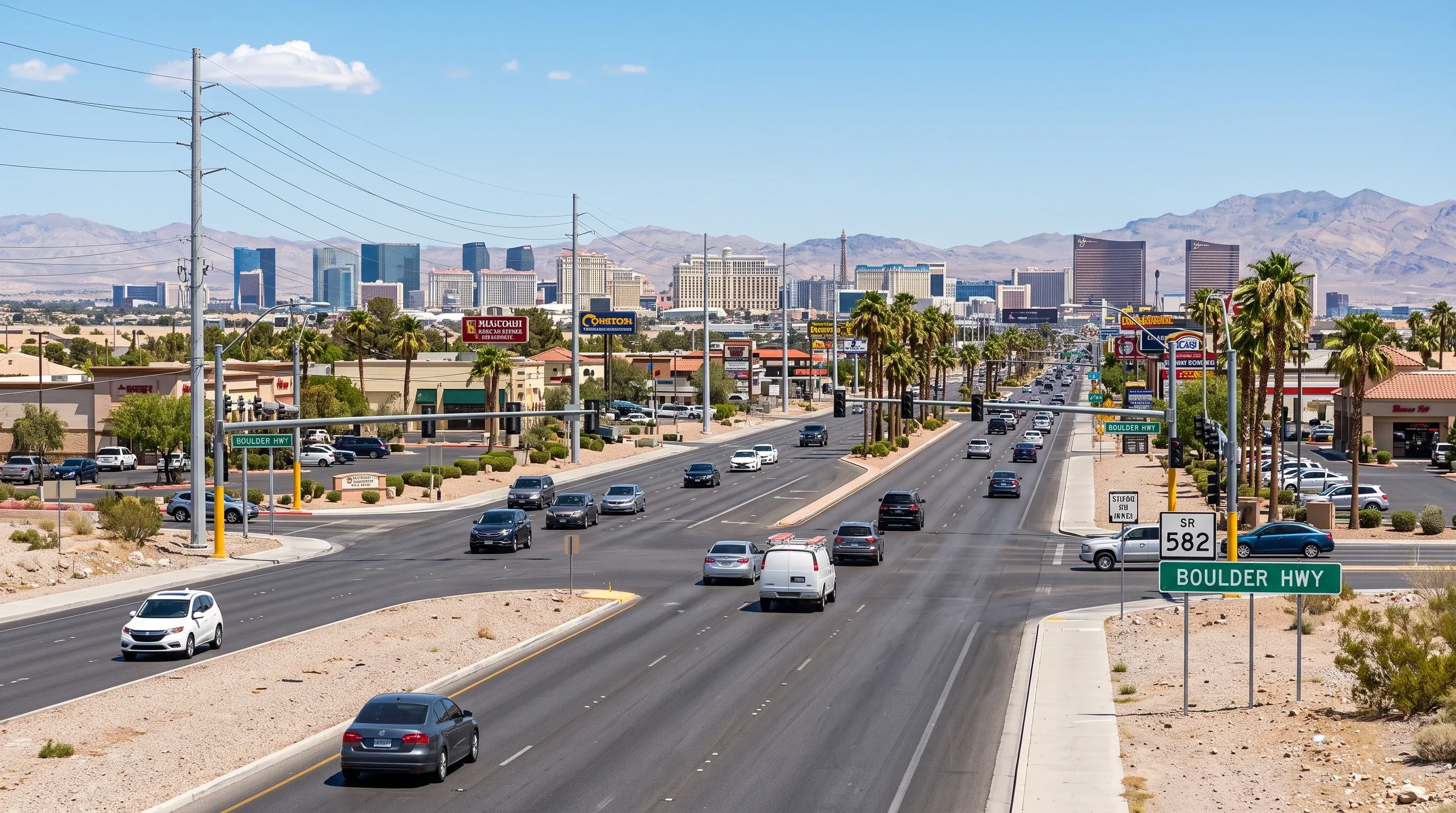
Families in Las Vegas and Henderson know Boulder Highway’s reputation, but that awareness rarely translates into safety. Pedestrians, transit riders, and motorcyclists share this corridor with drivers moving at 45 to 55 mph, and a single moment of inattention near a casino entrance, motel driveway, or RTC bus stop can end in a fatal or catastrophic injury crash. Survivors are left facing serious injuries, mounting medical bills, and the frightening realization that the same road they cross every day is statistically the deadliest stretch in the state.
The danger is harder to avoid than it looks because the road’s design works against pedestrians and drivers alike. Signalized crosswalks sit far apart, lighting is inconsistent after dark, and dozens of casinos and bars concentrate impaired drivers during the same late night hours when foot traffic is hardest to see. Even careful road users get caught in a corridor built for vehicle throughput, not for the people who live, work, and walk along it.
Understanding exactly why this stretch is so dangerous, and what to do if you or a loved one is hurt on it, gives you a real advantage after a crash. In this article, you will discover why SR-582 has Nevada’s highest fatal accident rate, where crashes concentrate along Boulder Highway, and how a car accident attorney can help you pursue full and fair compensation.
Why Does SR-582 Have Nevada’s Highest Fatal Accident Rate?
Boulder Highway has Nevada’s highest fatal crash rate because it moves vehicles at freeway speed through a corridor built for people on foot. It was designed to maximize throughput, not to protect pedestrians.
Four factors make this stretch lethal:
- Freeway Speeds Next to Foot Traffic: Posted limits of 45–55 mph leave drivers almost no time to react to a pedestrian in their path. At those speeds, a collision is almost always fatal.
- No Safe Place to Cross: In many segments, the nearest signalized crosswalk lies a quarter-mile away. Rather than walk that distance, many people attempt to cross eight or more lanes of traffic mid-block.
- Darkness and Poor Lighting: Most fatal pedestrian crashes on this road happen at night. Inadequate street lighting makes pedestrians in dark clothing invisible to oncoming drivers.
- A Corridor of Impaired Drivers: Dozens of casinos, bars, and 24-hour gaming halls line the route. This concentrates impaired drivers on the road during the same late-night hours when pedestrian visibility is at its worst.
Related: I-15 Through Nevada: Why It’s Been Called the ‘Highway to Hell’
Where Do Most SR-582 Fatal Crashes Happen?
The danger on Boulder Highway is not spread evenly. Crashes cluster at specific intersections and after dark.
The most dangerous junctions include Nellis Boulevard, Flamingo Road, Tropicana Avenue, and Sahara Avenue. At each of these crossroads, pedestrians must navigate multiple lanes of high-speed traffic while watching for vehicles turning from several directions at once.
There is also a structural problem tied to bus placement. Many RTC Regional Transportation Commission stops along Boulder Highway sit hundreds of feet from the nearest safe crossing. Rather than walk a long distance out of their way, transit riders often cross wherever they are, not where it is safe.
What we see consistently in the SR-582 claims we handle is that adjusters try to shift blame onto the pedestrian the moment a crash happens near Nellis Boulevard, Flamingo Road, Tropicana Avenue, or Sahara Avenue, pointing to jaywalking before any investigation into signal timing or crosswalk spacing has even started. Clients treated at Sunrise Hospital or Henderson Hospital after these intersection crashes often need follow-up imaging once swelling or a head injury fully presents, and insurers routinely use that delay to argue the injury was not caused by the crash.
Who Is Most at Risk on SR-582?
Pedestrians make up the largest share of SR-582 fatalities, but the danger reaches multiple groups of road users.
- Older Adults: Seniors often cannot clear multiple wide lanes before the signal changes. The highway’s widest intersections are especially dangerous for anyone who walks slowly.
- Transit Riders: Bus riders face repeated conflicts between high-speed traffic and stops that sit far from any safe crossing.
- Motorcyclists and Cyclists: Sudden lane changes, high speeds, and impaired or distracted drivers make this corridor one of the most dangerous in Nevada for anyone on two wheels.
Related: The Most Dangerous Intersections in Las Vegas
What Improvements Are Being Made to SR-582?
NDOT Nevada Department of Transportation, and RTC of Southern Nevada have launched the Boulder Highway Complete Streets project to redesign the corridor. These improvements address the right problems, but they take years to complete.
| Improvement | What It Does |
| Median Islands | Gives pedestrians a safe stopping point mid-crossing |
| HAWK Beacons | Pedestrian-activated signals that stop mid-block traffic |
| Road Diet | Reduces travel lanes to slow vehicle speeds |
| Lighting Upgrades | Improves nighttime visibility along the corridor |
| Bus Stop Relocations | Moves stops closer to signalized intersections |
A HAWK beacon, short for High-Intensity Activated crossWalK signal, is a mid-block crossing signal that pedestrians activate themselves to stop oncoming traffic. These changes are coming. Until they are in place, your habits are your only protection.
How Can You Reduce Your Risk on SR-582?
The most effective protection you have right now is how you use this road.
If you drive on Boulder Highway:
- Treat the posted speed as the ceiling, not the minimum
- Scan for pedestrians near every bus stop, driveway, and motel entrance, not just at marked crosswalks
- Never drive impaired on this corridor
- Put your phone away for the full length of the drive
If you walk or use transit:
- Cross only at signalized intersections, even when the walk is long
- Wear bright or reflective clothing at night and assume no driver can see you
- Do not step into the road until the driver has fully stopped and made eye contact with you
What Should You Do After a Crash on SR-582?
What you do in the first 24 hours shapes the outcome of your entire case. Here is what matters, in order.
Step 1: Call 911 immediately. Do not assume you are unhurt. Traumatic brain injuries and internal bleeding often produce no symptoms for hours after impact.
Step 2: Document the scene. Photograph both vehicles, road markings, skid marks, traffic signals, and any missing or damaged signage. Get the contact information of every witness before they leave.
Step 3: Act fast on video evidence. Casinos, businesses, and RTC buses along Boulder Highway all have cameras, and that footage deleted within seven days is typically erased. We can send a legal preservation letter immediately to stop that from happening.
Step 4: Do not give a recorded statement. Report the crash to your own insurer, but do not speak to the other driver’s insurance company without a lawyer. Adjusters are trained to ask questions that quietly damage your claim.
Step 5: Call Ladah Law. Our founder, Ramzy Ladah, spent years inside the insurance defense industry before switching sides. He knows their playbook. Now he uses it for you.
Across the crashes we have handled along this corridor, the casinos, motels, and businesses near Boulder Highway typically overwrite their surveillance footage on a rolling cycle, so a case that starts even a week late has already lost the video that would have settled who ran the light or who had the walk signal. What we consistently tell clients is that a preservation letter sent to the property or to RTC within the first few days is often the single factor that turns a disputed liability case into a straightforward one.
Who Can Be Held Liable After an SR-582 Crash?
Crashes on Boulder Highway rarely involve just one responsible party. Finding every liable party is how you access every available dollar of compensation.
- The At-Fault Driver: An impaired, speeding, or distracted driver is liable for your damages. If they were working at the time as a trucker, delivery driver, or rideshare operator, their employer may share liability too.
- A Government Entity: If a broken signal, missing crosswalk, or known road defect contributed to the crash, NDOT or Clark County may share responsibility. Claims against government entities follow a separate notice process under Nevada law, so identifying a government defendant early still matters.
- A Vehicle Manufacturer: If a brake failure, defective tire, or mechanical fault caused the crash, the manufacturer may be liable under product liability law.
Nevada follows modified comparative negligence, meaning you can still recover compensation even if you were partly at fault, provided your fault share 50% or less. Your award is reduced by your percentage of responsibility.
A pattern we consistently see in Boulder Highway liability claims is adjusters rushing to assign the injured pedestrian or motorcyclist a disproportionate share of fault before NDOT’s own maintenance and signage records have even been requested. In our experience, claims that name NDOT or Clark County as a defendant move differently than claims filed only against a driver, and they are the ones most likely to end up in the Eighth Judicial District Court once a government entity disputes liability.
How Long Do You Have to File an SR-582 Accident Claim?
Nevada’s statute of limitations, the legal deadline to file a lawsuit, gives you two years from the date of your injury. Miss that window, and you permanently lose the right to seek compensation.
If a government entity shares fault, Nevada law still requires you to file a notice of claim within two years under NRS 41.036, the same deadline as a standard injury claim. The longer you wait, the more evidence disappears.
Injured on SR-582? Call Ladah Law Today
The insurance company already has a team working against you. You need someone who has operated inside that system and knows exactly what they are doing.
Our firm has obtained substantial recoveries for injured Nevadans, including major verdicts and settlements in wrongful death, reckless driving, and trucking accident cases. Ramzy Ladah is certified as a Personal Injury Specialist State Bar, a distinction held by only a handful of attorneys in the entire state.
Every client gets their attorney’s direct cell number and 24/7 access throughout the life of their case. There is no fee unless we win.
Call today for a free case review. We serve Southern Nevada from three offices: Downtown Las Vegas, North Las Vegas, and Spring Valley.
Frequently Asked Questions
Is SR-582 the Same Road as Boulder Highway?
Yes, SR-582 is the official state route number for the road that locals know as Boulder Highway.
Does SR-582 Pass Through Both Las Vegas and Henderson?
Boulder Highway connects downtown Las Vegas to Henderson, passing through unincorporated Clark County along the way.
Are Pedestrians Still Entitled to Compensation if They Crossed Outside a Crosswalk on SR-582?
Under Nevada’s modified comparative negligence law, crossing mid-block may reduce a pedestrian’s recovery, but it does not automatically eliminate their right to seek compensation.
Can a Lawyer Recover Casino or Bus Camera Footage After an SR-582 Crash?
Yes, but only if a preservation letter is sent before the footage is deleted, which can happen within days of the crash.
Can Out-of-State Visitors File an SR-582 Injury Claim?
Yes, Nevada courts have jurisdiction over any crash that occurs here, and we handle cases for out-of-state clients entirely remotely.
What If the At-Fault Driver’s Insurance Doesn’t Cover Your Full Damages?
Your own Uninsured/Underinsured Motorist UM/UIM coverage can fill the gap, and we can investigate whether other parties, such as an employer, a bar, or a government entity, also share liability.