
The Spaghetti Bowl, the I-15/US-95 interchange north of downtown Las Vegas, is one of Nevada’s most crash-prone roads. Its 1960s-era design was never built for today’s traffic, and merge zones, sharp curves, freight traffic, and confused tourists all raise the risk of a crash. A collision here can leave you facing severe injuries, mounting bills, and an insurer building a case against you.
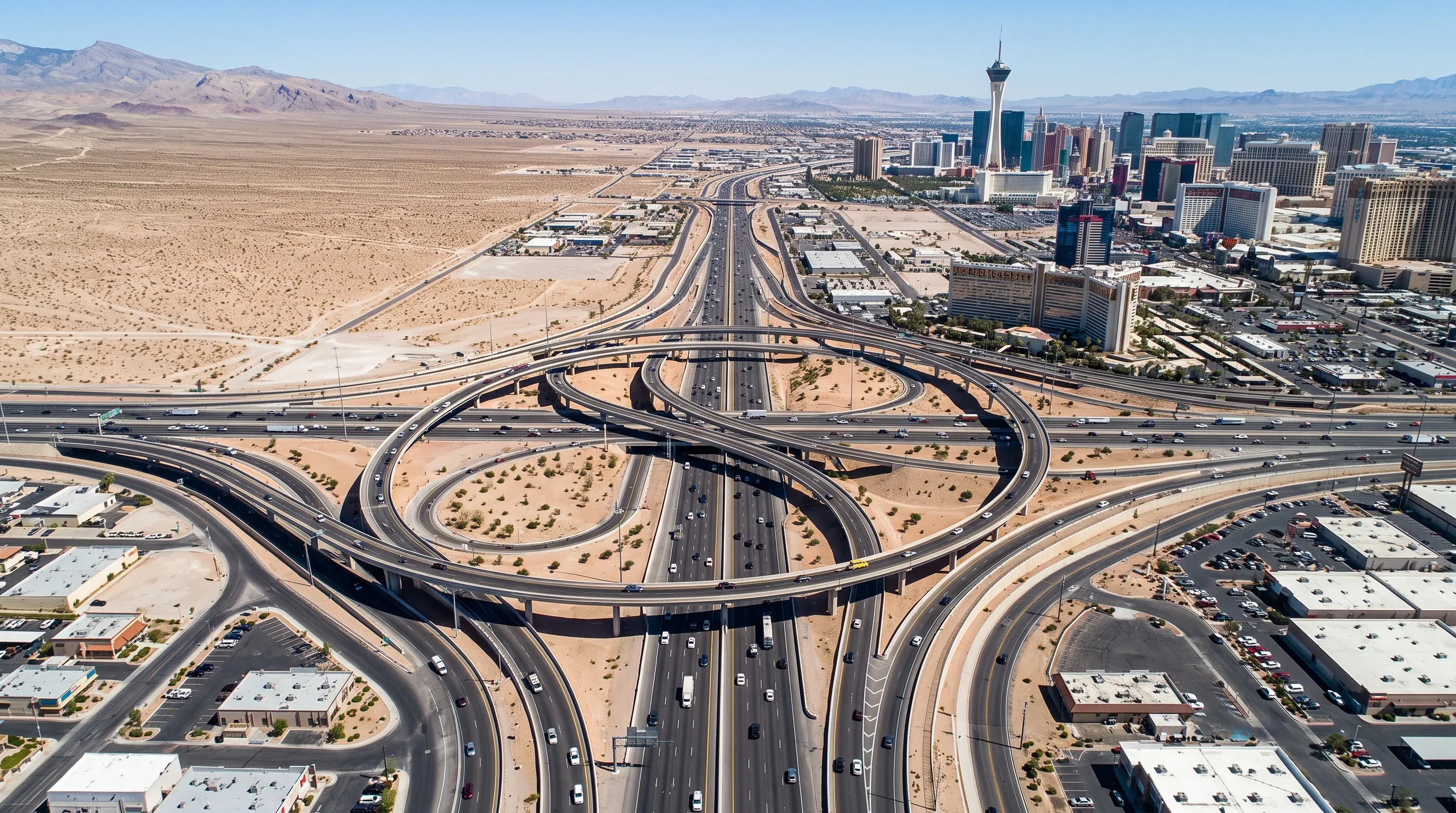
A crash at the Spaghetti Bowl often happens in the middle of a multi-lane weave, sandwiched between freight trucks and drivers making last-second lane changes to reach the Strip or catch I-15 South. Injuries here tend to be severe, including whiplash, concussions, spinal damage, and broken bones from high-speed impacts on tight connector ramps. In the chaos that follows, you are left trying to document a crash scene spread across overlapping flyovers while insurance adjusters start working the case against you.
The challenge gets harder because the interchange’s tangle of ramps makes fault difficult to pin down, especially in the multi-vehicle pileups common at the Spaghetti Bowl. NDOT traffic camera footage that could prove what happened is often overwritten within days, and Nevada’s modified comparative negligence rule gives insurers an opening to shift blame onto you and reduce what they pay. Even after the nearly $1 billion Project Neon reconstruction, the interchange’s outdated 1960s geometry still creates hazards that catch drivers off guard.
In this article, you will discover what makes the Spaghetti Bowl so dangerous, what Project Neon did and did not fix, how Nevada law decides fault, and how a auto accident lawyer can help you pursue the compensation you deserve.
What Is the Spaghetti Bowl?
The Spaghetti Bowl is the massive freeway interchange north of downtown Las Vegas where Interstate 15, US-95 (co-signed as Interstate 11 since 2024), and Martin Luther King Boulevard all meet in one tangle of overlapping ramps and flyovers. Locals gave it the name because from above, the road layout looks exactly like a bowl of pasta.
Built in the 1960s for a far smaller city, it now carries an enormous daily volume of commuters, tourists, and freight trucks, all competing for space on roads never designed to hold them.
What Makes the Spaghetti Bowl Dangerous?
The core problem is simple: an outdated design is being asked to handle far more traffic than it was built for. Short merge zones, sharp curves, confusing signage, and a constant mix of trucks and passenger vehicles make crashes not just possible but predictable.
Here is what drives the danger:
- Speed differences: Passenger cars move fast. Freight trucks cannot. That gap between vehicles trying to merge and traffic already on the freeway is the leading cause of rear-end and sideswipe crashes here.
- Weave zones: A weave zone is a short stretch where entering and exiting traffic must cross each other’s paths at the same time. This means drivers have only seconds to navigate multiple lane changes before running out of road.
- Sharp curves: Many connector ramps require significant speed reduction. Drivers who miss that cue, especially first-time visitors, lose control and strike barriers or other vehicles.
- Tourist traffic: A large share of Spaghetti Bowl drivers are visitors navigating it for the first time. Tightly packed signs for the Strip, I-15 South, and US-95 North trigger panic and sudden, last-second lane changes.
- Freight trucks: I-15 is a major freight corridor linking Southern California to Utah. Big rigs on tight ramps at highway speeds are a serious danger to smaller passenger vehicles.
- Nighttime surges: Las Vegas entertainment traffic funnels directly through the interchange. Late nights and weekends bring a sharp rise in impaired and fatigued driving, making an already dangerous stretch even deadlier.
Where Are the Worst Crash Spots at the Spaghetti Bowl?
Crashes concentrate at specific locations where confusing design, heavy volume, and critical decision points all stack on top of each other.
| Hotspot | Why It’s Dangerous |
| I-15 / US-95 Flyover Ramps | High speeds, tight curves, and last-second lane changes create constant sideswipe risk |
| Charleston Blvd / I-515 Interchange | Heavy backups cause sudden stops and chain-reaction rear-end collisions |
| Downtown to Strip Corridor on I-15 South | Tourists and commuters compete aggressively for the same exits in a short stretch of road |
| Martin Luther King Blvd On-Ramps | Extremely short merge lanes force drivers into fast-moving traffic with almost no room |
| I-15 Southbound Approach | Traffic stops suddenly ahead of the interchange, catching high-speed drivers off guard |
The pattern is the same everywhere: too little space, too much volume, and drivers forced into split-second decisions in a place that punishes any mistake.
One pattern we consistently see in Spaghetti Bowl crash claims is that the worst wrecks cluster at the connector ramps where I-15 South traffic merges into US-95 North, and at the flyover carrying Martin Luther King Boulevard traffic beneath the interchange. Clients hurt in these collisions are frequently taken to University Medical Center’s trauma unit, the only Level I trauma center in Nevada, which tells you how severe these impacts tend to be. When we file these claims in the Eighth Judicial District Court, the crash reports almost always tell the same story: a driver caught off guard by a lane drop or a sudden merge with nowhere left to go.
What Did Project Neon Change?
Project Neon was a reconstruction project by the Nevada Department of Transportation (NDOT) that rebuilt and widened portions of I-15 through the Las Vegas corridor. The project widened I-15 for more than three miles through the corridor, converted express lanes into HOV (high-occupancy vehicle) lanes reserved for carpools, added ramp meters to regulate merging traffic, rebuilt the Charleston Boulevard interchange, and installed electronic signs that warn drivers about real-time crashes and congestion.
The improvements are real. But Project Neon could not fix the interchange’s 1960s-era geometry, and traffic volume keeps climbing. Active construction zones continue to create new lane shifts and detours that keep confusion and crash risk, high for drivers who use this interchange every day.
What to Do after a Spaghetti Bowl Crash
A crash in the Spaghetti Bowl is chaotic and dangerous. Secondary crashes, where a second vehicle strikes one already stopped in a travel lane, are a serious and deadly risk at high-speed interchanges. Your first move is always to get to safety.
1. Call 911. Report the crash and any injuries immediately. A police report creates an official record that becomes critical evidence in your claim.
2. Document everything. Photograph vehicle positions, all visible damage, lane markings, nearby signage, and your injuries. Get witness contact information before they drive away.
3. Get medical care the same day. Injuries like whiplash, concussions, and internal trauma often have delayed symptoms. A gap in treatment gives insurance companies the argument that the crash did not cause your injuries, and they will use it to cut your payout.
4. Decline a recorded statement. Report the crash to your own insurer, but do not give a recorded statement to the other driver’s insurance company before speaking with an attorney. Their adjusters are trained to get you to say something that reduces your claim.
5. Call us immediately. NDOT camera footage is often overwritten within days. We send a preservation letter right away to lock that evidence down before it is gone.
How Nevada Law Decides Fault
Nevada is an at-fault state, meaning the driver who caused the crash is financially responsible for your injuries and damages. Nevada also uses a rule called modified comparative negligence; this means your compensation is adjusted based on your share of fault in the accident, and that adjustment directly determines what you walk away with.
The 51 Percent Rule
You can recover damages in Nevada as long as you are found 50% at fault or less. If you are found 51% or more responsible, you recover nothing. If a jury finds you 20% at fault in a $100,000 case, your recovery drops by 20%, so you receive $80,000.
Insurance companies know this rule inside and out, and they use it aggressively to shift as much blame onto you as possible and reduce what they owe.
How We Prove Fault in a Multi-Vehicle Crash
Spaghetti Bowl pileups often involve three or more vehicles, with multiple carriers all pointing fingers at each other. We cut through that noise with hard evidence:
- Black-box data: Most modern vehicles have an event data recorder (EDR) that captures speed, braking, and steering inputs in the seconds before impact.
- Camera footage: We send immediate preservation requests to NDOT and nearby businesses before video is deleted.
- Cell phone records: Subpoenaed records can prove a driver was texting at the exact moment of the crash.
- Accident reconstruction experts: We hire engineers who rebuild the crash sequence and testify to exactly who caused it.
What we see across the multi-vehicle pileups we handle from the Spaghetti Bowl is that every carrier’s insurer shows up with its own version of events within days of the crash, each one pointing at a different driver. A tactic we see repeatedly from adjusters handling these Clark County claims is disputing the black-box data pull, especially when it contradicts the story their insured gave in a recorded statement. That is why we move fast to subpoena cell phone records and lock down NDOT camera footage before it disappears, because in a five-car pileup on the connector ramps, the evidence that survives is usually what decides who pays.
What if a Semi-Truck Was Involved?
Truck accident cases are an entirely different fight. Commercial trucking companies are governed by federal regulations set by the Federal Motor Carrier Safety Administration (FMCSA), and critical evidence, driver logbooks, hours-of-service records, maintenance files, and post-crash drug and alcohol tests, must be preserved through a legal hold letter within days of the crash or it may be gone forever.
Trucking companies send rapid-response investigators to crash scenes within hours of impact. You need a firm that moves just as fast. We have the results to back that up, a $10 million jury verdict in a trucking accident case. We know how to match the industry’s firepower and win.
In one case we handled, a 35-year-old woman was struck by two tractor-trailers in a single collision. The defense argued she was at fault, and multiple neuropsychologists testified she had suffered no cognitive deficits or brain injury, despite her ongoing memory loss, confusion, and communication difficulties. We took the case to trial, and after seven days of proceedings, the jury awarded $2,436,468.40, prompting the defendants, who had been confident in a defense verdict, to offer their $2 million policy limits before the verdict was even final.
What Compensation Can You Recover?
An insurance company’s first offer rarely covers the true cost of a serious injury. We fight for the full value of your claim, which can include:
- Medical expenses: Emergency care, surgery, imaging, physical therapy, and projected future treatment
- Lost wages and earning capacity: Income already lost and reduced future earnings if you cannot return to your previous work
- Pain and suffering: Physical pain, emotional distress, anxiety, and lost enjoyment of life
- Property damage: Vehicle repair or replacement and its diminished market value after the crash
- Wrongful death damages: Full financial and emotional losses for families who have lost someone in a fatal collision
We prepare every case for trial. When insurers know we will take a case all the way to a jury, they pay more. Our track record proves it, over $400 million recovered for clients, including a $70.6 million wrongful death judgment.
“I was rear-ended when I was pregnant and had to have multiple surgeries. I’m beyond grateful for everybody and I would definitely recommend Ramzy Ladah and his law firm to anyone who’s looking for a great lawyer.” – J.L
Injured at the Spaghetti Bowl? Contact Ladah Injury & Car Accident Lawyers Las Vegas Today
The moment a crash happens, the insurance company on the other side starts building a case against you. They have investigators, lawyers, and decades of institutional experience designed to minimize what they pay. Most injured drivers walk into that fight completely outgunned.
Firm founder Ramzy Ladah began his career defending those same insurers. That insider knowledge now works exclusively for you. Ramzy is a Nevada State Bar certified personal injury specialist and the 2024 Litigator of the Year. Other attorneys trust us with their toughest cases because they know we fight, and win.
“Hi, my name is Dina Martinez. My lawyer’s name is Ramzy Ladah. He is the best lawyer I know. I had another lawyer before I got in this car accident but my lawyer didn’t work the way I wanted. I was so scared because these big, old companies with their big lawyers – you’re scared because you don’t know what is the best way of dealing with them. Ramzy Ladah does exactly what I want. The way he fights in court for me was really good. It was like my family member fighting for a family member. It wasn’t like a lawyer fighting for just somebody, like other lawyers do. I recommend Ramzy Ladah because he does a really, really good job. With these big old companies you have to deal with when you have a car accident, its kind of impossible for a regular, normal person. So you need a lawyer – that’s Ramzy Ladah. We won and we got a lot of money and I’m so happy about it.” – Dina Martinez
Call us now for a free consultation. No fees unless we win.
Frequently Asked Questions
When Do Most Crashes Happen at the Spaghetti Bowl?
Traffic congestion during weekday rush hours and late weekend nights can increase crash risk at the interchange.
How Quickly Is NDOT Traffic Camera Footage Overwritten?
NDOT footage is typically overwritten within days of a crash. We send a formal evidence preservation letter the moment you contact us to secure that footage before it disappears.
Do Out-of-State Visitors File Injury Claims in Nevada or Their Home State?
If you were injured at the Spaghetti Bowl, your personal injury claim must be filed in Nevada because the accident occurred here and is governed by Nevada law, regardless of where you live.
What Happens if the Driver Who Hit You Fled the Scene?
If the at-fault driver fled, you may be able to file a claim through your own Uninsured Motorist (UM) coverage, insurance that protects you when the responsible driver cannot be found or has no insurance.
How Long Do You Have to File an Injury Claim in Nevada?
Nevada’s statute of limitations, the legal deadline to file, is generally two years from the date of your accident, though some exceptions can shorten that window, so contact an attorney as soon as possible.
Can a Dangerous Road Design Affect Who Is at Fault in a Crash?
Yes. If a defective design element, a poorly marked ramp, missing guardrail, or inadequate signage, contributed to your crash, it may be possible to bring a claim against the government entity responsible for the road.