
Flamingo Road and Rainbow Boulevard is one of the most dangerous intersections to navigate for visitors and locals in Las Vegas. Two six-lane arterials meet in Spring Valley, pushing high volumes of commuter, rideshare, and tourist traffic through a signalized intersection with complex turn phases and high approach speeds.
The result is a predictable pattern of left-turn T-bones, rear-end pileups, and red-light-runner collisions that send drivers, passengers, and pedestrians to the hospital every week, and most people hurt here have no idea which of those specific crash patterns applies to their case or what evidence actually proves it.
That uncertainty works against you. Insurers know this intersection produces expensive injury claims, and they are prepared to fight yours the moment you file it, while the surveillance footage and signal data that could prove what really happened disappears within days.
If you were hurt at Flamingo and Rainbow, our Spring Valley office is minutes away and we already know this intersection. In this article, you will discover why it produces so many serious crashes, what evidence proves fault, who can be held legally responsible under Nevada law, and how a Las Vegas personal injury attorney can protect your claim from day one.
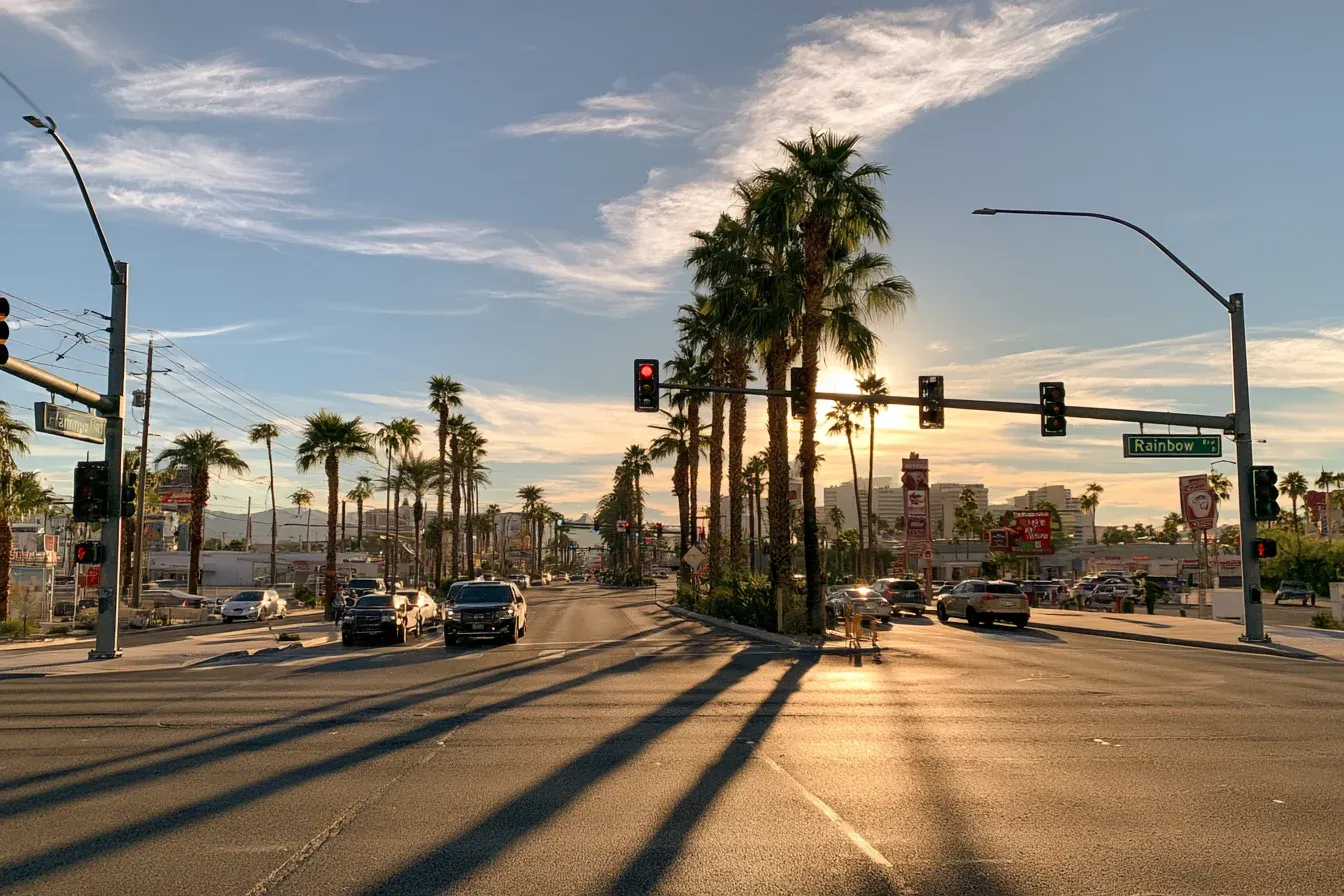
Where Is Flamingo Road and Rainbow Boulevard?
Flamingo Road and Rainbow Boulevard is a major intersection in Spring Valley, roughly three miles west of the Las Vegas Strip. It is where a primary east-west artery, Flamingo, crosses a major north-south route, Rainbow, funneling thousands of drivers daily between the 215 Beltway, dense residential neighborhoods, and busy commercial centers. Gas stations, grocery stores, and dozens of restaurants sit on all four corners, drawing constant foot traffic and making this one of the most active, and dangerous, crossroads in west Las Vegas. Our Spring Valley office is minutes from this intersection, which means we see the injuries it produces every single week.
Why Is Flamingo and Rainbow a Crash Hotspot?
This intersection generates a disproportionate number of serious crashes because of three overlapping problems: enormous traffic volume, confusing turn phases, and an unpredictable mix of drivers. Wide, flat roads invite high approach speeds into a signalized intersection, and GPS-dependent tourists and rideshare drivers regularly make sudden, unexpected moves.
Here is what makes this corner uniquely dangerous:
- High Traffic Volume: Two six-lane arterial roads feed directly into the 215 Beltway, keeping this intersection busy with cars from early morning through late night.
- Complex Turn Phases: All four approaches have dedicated left-turn lanes with both protected and unprotected signal phases, creating constant confusion about when it is safe to turn.
- Tourist and Rideshare Traffic: Unfamiliar drivers relying on navigation apps routinely make sudden lane moves without anticipating what is directly ahead of them.
- High Approach Speeds: The road geometry, straight, wide, and flat, encourages drivers to approach the intersection at 45 mph or more.
- Visual Distractions: Dense retail signage, restaurant entrances, and heavy pedestrian activity constantly pull driver attention off the signal ahead.
Insurers know this intersection produces expensive injury claims, and they are prepared to fight yours the moment you file it.
What Types of Crashes Happen Here?
Because of this intersection’s layout and traffic mix, a few specific crash types dominate. We have handled cases across all of them, including settlements and wrongful-death judgments arising from similar crashes.
- Left-Turn T-Bones: A driver turns left on a stale yellow or unprotected green and is struck by oncoming traffic at full speed, the most common serious crash at this intersection.
- Rear-End Collisions: Sudden stops for changing lights trigger chain-reaction pileups, especially in the eastbound Flamingo lanes during peak commute hours.
- Red-Light-Runner Broadsides: The most violent crashes here, a driver blows through a red and strikes another vehicle broadside, often at full speed with no braking at all.
- Pedestrian and Cyclist Strikes: Long crosswalks and right-turn-on-red drivers create predictable, dangerous conflicts with people crossing the street.
When Are Crashes Most Likely to Happen?
A crash can occur here at any hour, but the risk spikes at predictable times. Our investigators know exactly what evidence to look for depending on when your collision happened.
| Time Window | Primary Risk |
| 7–9 a.m. Weekdays | Commuter rear-ends and direct sun glare in eastbound drivers’ eyes on Flamingo |
| 4–7 p.m. Weekdays | Peak-hour volume driving aggressive left-turn crashes and dangerous lane changes |
| 10 p.m.–2 a.m. Fri/Sat | Impaired drivers leaving the Strip and nearby entertainment venues |
| Holiday Weekends | Tourist unfamiliarity with the intersection layout and a surge in rideshare activity |
The intersection is never truly quiet. That is why we respond immediately when you call us, because the right evidence does not stay available for long.
What to Do After a Crash at Flamingo and Rainbow
The actions you take in the first 72 hours directly shape the strength and value of your claim. Follow these steps in order.
Call 911 and Get Medical Care
LVMPD will dispatch an officer to document the crash in an official police report, one of the most critical pieces of evidence in your case. Accept medical treatment at the scene even if you feel fine, because adrenaline routinely masks serious head, neck, and internal injuries.
Document the Scene Before Anything Moves
Photograph vehicle positions, property damage, skid marks, and the traffic signals from multiple angles before anything is towed or cleared. These photos can become the backbone of your entire claim.
Find Witnesses and Identify Nearby Cameras
Nearby businesses at the intersection may have exterior surveillance cameras, try to preserve any footage as soon as possible. Get the names and phone numbers of any witnesses before they leave the scene.
Do Not Give a Recorded Statement
The other driver’s insurer may ask you for a recorded statement, do not provide one until you have spoken with an attorney. Do not agree. A single misquoted phrase can be used against you for the life of your claim. Tell them: “I’m not ready to make a statement until I speak with my attorney.”
Call Ladah Law
We send investigators to the intersection the same day you contact us, move immediately to preserve surveillance footage, and put the insurance company on formal legal notice. You pay nothing until we win.
How We Prove Fault at Flamingo and Rainbow
Your word alone is not enough in a contested intersection crash. We build cases on objective evidence that cannot be argued away, and at a signalized intersection, that evidence runs deep.
The LVMPD traffic report establishes the official record of what happened. RTC FAST cameras, operated by the Regional Transportation Commission to monitor traffic flow, may have captured the crash itself. Private business surveillance from storefronts on all four corners fills in angles that no official camera covers.
We also pull data from Event Data Recorders, or EDRs. An EDR is a device built into most modern vehicles, similar to an airplane’s black box, that records speed, braking, and steering in the seconds before a crash. This data can prove the other driver never hit the brakes. If the at-fault driver was texting or checking a navigation app at the moment of impact, we can subpoena their cell-phone records as direct proof of distracted driving.
One pattern we consistently see in crashes at this intersection is a driver claiming the light was still yellow when RTC FAST camera timing data proves otherwise. What we see across these claims is that pulling the actual signal-phase log, not just relying on the police report’s summary, is what settles the dispute.
Who Can Be Held Responsible?
Once we establish how the crash happened, we identify every party who can be held legally responsible for your injuries. In a complex intersection crash, that often means pursuing more than one defendant.
- The At-Fault Driver: The starting point, pursued through their personal auto liability insurance policy.
- A Rideshare Company: If the at-fault driver had an active Uber or Lyft passenger at the time of the crash, a $1 million commercial policy may apply to your injuries.
- A Commercial Operator: Delivery vans, shuttle buses, and company trucks frequently travel this corridor, and commercial coverage is often far larger than any personal auto policy.
- A Government Entity: If a malfunctioning traffic signal or dangerous road design contributed to the crash, we can file a claim against the responsible agency, but these cases carry strict, short deadlines.
Nevada follows the modified comparative negligence rule, a legal standard that lets you recover compensation as long as you are 50% or less at fault for the crash. Your award is reduced by your percentage of responsibility. Insurance companies push this rule hard in intersection cases because it gives them a way to shift blame and shrink what they pay. Ramzy Ladah spent the early years of his career defending insurance companies, and he now uses that inside knowledge exclusively for you.
A tactic we see repeatedly from rideshare companies after a crash at this corner is denying that their driver was logged into the app at the time of impact. What we see across these claims is that subpoenaing the driver’s trip data directly from Uber or Lyft, rather than accepting the company’s initial answer, is what confirms whether the commercial policy applies.
What Can You Recover?
A successful personal injury claim covers every way this crash has damaged your life, today and into the future. We have achieved substantial verdicts and settlements for our clients, including major wins in reckless driving and trucking accident cases.
You can seek compensation for:
- Past and future medical bills
- Lost wages and income during your recovery
- Loss of future earning capacity if your injuries are permanent
- Pain and suffering
- Property damage to your vehicle
- Wrongful death damages if a loved one was killed
We do not just measure success by the settlement we secure today, we measure it by your quality of life tomorrow.
Why Insurance Companies Fight These Claims Hard
Insurers track crash data intersection by intersection. They know Flamingo and Rainbow produces expensive claims, and they have adjusters who see cases from this exact corner regularly, armed with pre-built arguments designed to minimize what you collect. Their standard playbook: make a fast, low offer and hope you accept before you understand what your case is really worth.
Our approach is the opposite. We build every case from day one as though it is heading to a jury, because that willingness to go all the way to a verdict is the only real leverage that forces insurers to pay full and fair value. It is why other Nevada personal injury attorneys refer their hardest cases to us, and why Ramzy Ladah is a litigator known for handling complex, high-stakes personal injury cases.
“I’m Gloria Evans and I had a personal injury accident. I was hoping to get reimbursed for some of it and went to an attorney who said she didn’t think she could handle the case but referred me to Ramzy. Ramzy took over and he and his staff did just a wonderful job. They got me more money than I thought that I would get. Everything was efficient. They kept me up to date on all the steps that we went through. And, I was just very pleased and would recommend them to anyone else.” – Gloria Evans
Injured at Flamingo and Rainbow? Contact Ladah Law Today
If you were hurt at this intersection, you do not have to face the insurance companies alone. Your consultation is always free, you get direct cell-phone access to your attorney, and we are available 24/7. Our Spring Valley office is just minutes from this intersection. No fee until we win, that is Ladah Money™.
“Ramzy is just very thorough, and he explains things very well. He was in contact with me consistently. I felt like I knew what was going on at all times. And the way he prepared me made me feel very, confident in both my ability to testify and also in his strategy. If you are hurt, if you’ve been in a car accident, if you have been injured in some way, I would recommend Ladah Law.” – A. Wilson
Frequently Asked Questions
Are There Traffic Cameras at Flamingo Road and Rainbow Boulevard?
Yes. The Regional Transportation Commission operates FAST cameras at this intersection, but footage is not always retained for long. Private businesses at all four corners also have their own surveillance cameras, and you must act within 72 hours to preserve that video before it is erased.
How Do I Get the LVMPD Crash Report for My Accident?
LVMPD reports are typically available online or in person within 7 to 10 business days after the crash. When you hire us, we request the official report immediately on your behalf.
What If the At-Fault Driver Ran a Red Light but Denies It?
Red-light denial is common. We prove these cases through surveillance footage, EDR data, and witness testimony, objective evidence the other driver cannot contradict simply by telling a different story.
Can I Still Recover Damages if I Was Turning Left?
Yes. Making a left turn does not automatically make you at fault under Nevada law. Under the state’s modified comparative negligence rule, you can still recover full compensation as long as you are 50% or less responsible for the crash.
What Happens If the At-Fault Driver Is Uninsured?
Your own Uninsured/Underinsured Motorist coverage, called UM/UIM, steps in when the at-fault driver cannot pay. UM/UIM is a protection on your own policy that covers your injuries in that situation, and we fight your own insurer with the same force we bring to every other case.
How Long Do I Have to File a Claim in Nevada?
Nevada gives you two years from the date of the crash to file a personal injury lawsuit. If a government entity is a potential defendant, such as when a defective traffic signal contributed, a separate formal notice of claim is required under NRS 41.036, but that notice deadline is the same two years, not shorter.
Do Tourists and Rideshare Passengers Have the Same Rights as Local Residents?
Yes. Nevada law protects injured tourists and rideshare passengers exactly the same as local residents, and Uber and Lyft are required to carry at least $1 million in commercial insurance coverage for crashes involving a passenger in the vehicle.