
After a hit and run in Nevada, call 911, stay at the scene, and record every detail you can about the fleeing vehicle. Then collect witness contact information, file a police report, get medical care, and notify your own insurance company right away. Each step protects your health, meets your legal obligations under Nevada law, and builds the foundation of your compensation claim.
A driver who hits you and speeds off leaves you with injuries, a damaged car, and no one to hold accountable at the scene. On busy Las Vegas roads like Boulder Highway, Tropicana Avenue, or the I-15 corridor, it can happen in seconds, and the shock makes it hard to think clearly about what to do next.
Without the other driver’s insurance information, your recovery often depends on your own uninsured motorist coverage, and your own insurer will look for reasons to pay less. Evidence that could identify the driver, like surveillance video and paint transfer, can disappear within days.
In this article, you will discover Nevada’s hit-and-run laws, the exact steps to take at the scene, which insurance pays when the driver cannot be found, and how a Las Vegas hit and run lawyer can protect your right to compensation.
What Is a Hit and Run in Nevada?
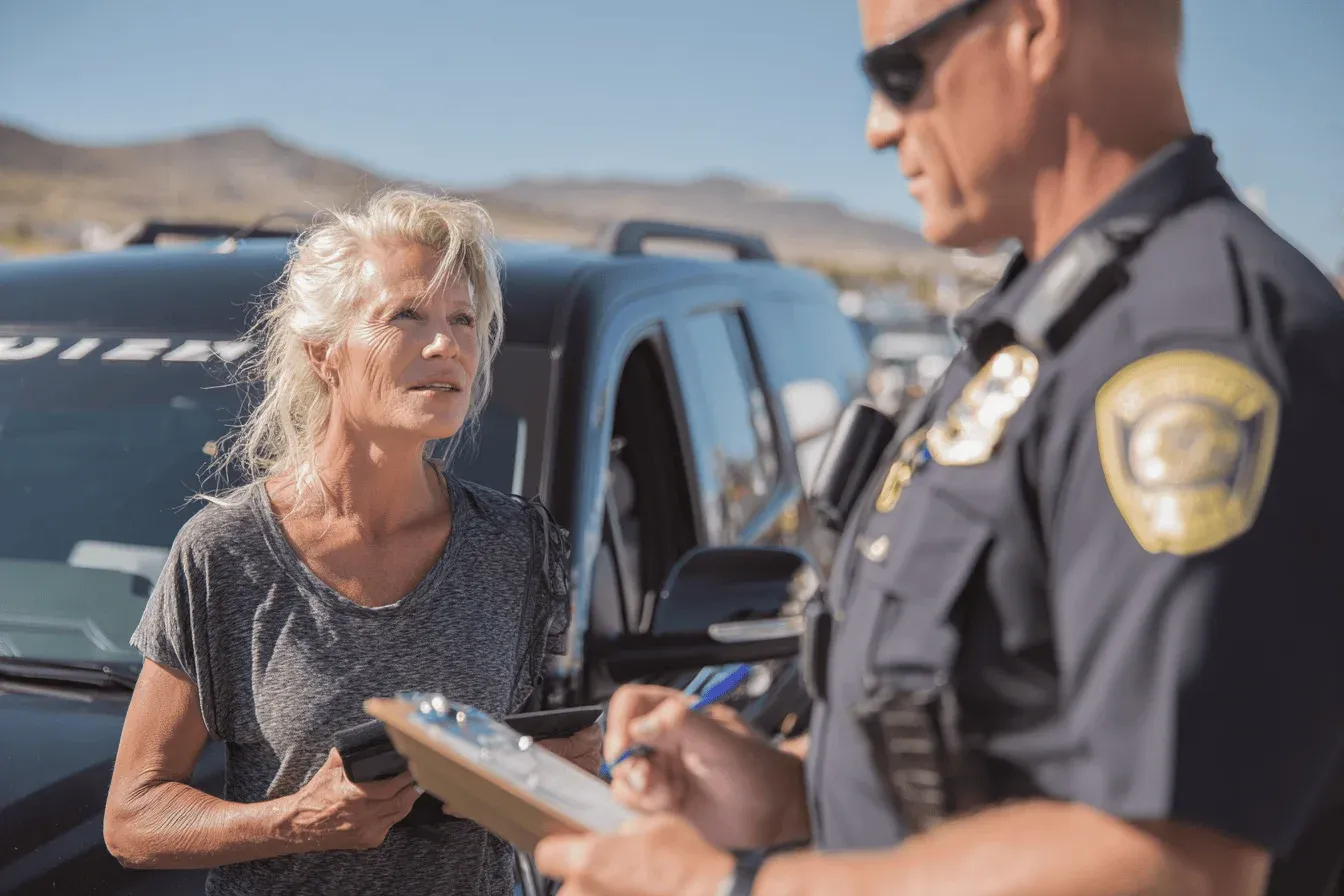
A hit and run is any crash where the driver flees without stopping to exchange information or help those they injured. Under Nevada law, this is a crime, and it applies to any collision involving another vehicle, a pedestrian, a cyclist, or even a parked car with no one inside.
When a driver flees, two things happen immediately: a criminal investigation begins, and your path to compensation becomes more complicated. Your next steps determine how much you can recover.
What Does Nevada Law Require After a Crash?
Even when the other driver breaks the law, you are still legally required to fulfill your own duties. Skipping any of these steps can damage your credibility and your claim.
Under NRS 484E.010 through 484E.030, every driver involved in a crash must:
- Stop immediately at or near the scene
- Move your vehicle out of traffic, but only if it is safe to do so
- Exchange your name, address, registration number, and driver’s license
- Render reasonable assistance to anyone injured, including arranging medical help
- Report the crash to police or the Nevada Highway Patrol if no officer arrives at the scene
Do your part, even when the other driver did not.
What Should You Do After a Hit and Run in Nevada?
Your first priority is safety. Your second is evidence. Call 911, stay at the scene, document the fleeing vehicle, report the crash, notify your insurer, get medical care, and call an attorney. Every action you take in the first few hours shapes what you can ultimately recover.
Step 1: Call 911 and Get to Safety
Dial 911 immediately to request police and medical assistance. Do not assume you are unhurt. Adrenaline can mask serious injuries for hours, and what feels like soreness could be a concussion or internal bleeding.
Step 2: Do Not Chase the Driver
Never follow a fleeing driver. Chasing them is dangerous, can expose you to criminal liability, and destroys your value as a witness. Your job is to observe, memorize, and report.
Step 3: Record Every Detail About the Fleeing Vehicle
Use your phone’s voice memo or notes app while the scene is still fresh. Capture:
- The full or partial license plate number
- The vehicle’s make, model, and color
- The direction the driver fled
- Any visible damage on the fleeing car
- A description of the driver, if you saw them
Step 4: Photograph Your Injuries, the Vehicles, and the Scene
Document your vehicle’s damage, your physical injuries, skid marks, and road debris. Paint transfers and broken parts left behind by the fleeing car can be matched to a specific vehicle, and they are some of the most powerful physical evidence in these cases.
Step 5: Get Witness Information and Look for Cameras
Collect names and phone numbers from any witnesses before they leave the scene. Look for surveillance cameras at gas stations, storefronts, ATMs, and nearby homes. This footage can identify the driver, but it is often deleted within days if not formally preserved.
One pattern we consistently see in Las Vegas hit-and-run claims is that the best footage comes from places drivers never think about, like a gas station on Boulder Highway, a casino garage camera, or a neighbor’s doorbell a block from the crash. What we see across these cases is that many businesses overwrite video within days, so a preservation letter sent in the first week is often the difference between identifying the driver and filing against your own UM policy.
Step 6: Report the Hit and Run to Police
If no officer responds to the scene, Nevada law still requires you to file a report. Contact the Las Vegas Metropolitan Police Department (LVMPD) or Nevada Highway Patrol (NHP) directly. This official police report is the foundation of your insurance claim and any criminal case against the driver.
Step 7: File a Nevada DMV Report if Required
Under NRS 484E.070, you must submit a written crash report to the Nevada DMV within 10 days if the accident resulted in injury, death, or more than $750 in property damage. You are exempt only if a police officer already filed an official report at the scene that includes insurance information.
Step 8: Get Medical Care Right Away
See a doctor within 24 hours, even if you feel fine. Concussions, soft-tissue injuries, and internal bleeding can take days to surface. Prompt medical care creates the official record that links your injuries directly to the crash. Without it, insurers will argue your injuries came from somewhere else.
Step 9: Notify Your Insurer Without Giving a Recorded Statement
Report the crash to your own insurance company promptly to open your claim. Stick to the basic facts, decline to provide a recorded statement until you have spoken with an attorney, and never speculate about your injuries or fault.
“Insurance companies pretend to be your friend. But they’re only trying to set you up to fail.” – Adrian Karimi
Step 10: Preserve Your Dash Cam Footage and Vehicle
Download your dash cam video immediately and back it up in multiple places. Do not repair your vehicle until all damage has been thoroughly documented. For nearby surveillance cameras, a formal preservation letter from your attorney is the most reliable way to prevent that footage from being deleted.
Who Pays After a Hit and Run in Nevada?
When the at-fault driver disappears, you turn to your own insurance policy for compensation. Most Nevada hit-and-run recoveries come from three specific types of coverage.
Uninsured Motorist Coverage
Uninsured Motorist (UM) coverage treats a hit-and-run driver the same as an uninsured driver. This means your UM policy steps in to pay your medical bills, lost wages, and pain and suffering, up to your policy limits. UM coverage is optional in Nevada, but it is the most important protection you can carry.
“Nevada has a much more advantageous law in collecting the money you’re paying for every month to be able to collect.” – Adrian Karimi
MedPay Coverage
Medical Payments (MedPay) coverage pays your initial medical bills regardless of who caused the crash. It covers emergency costs like ambulance fees and ER visits while your larger UM claim is still being resolved.
Collision Coverage
Collision coverage pays to repair or replace your vehicle after a hit and run, minus your deductible. It handles your property damage separately from your injury claim.
A tactic we see repeatedly from insurers handling Las Vegas hit-and-run claims is questioning whether a phantom driver existed at all, especially in single-car crashes on the I-15 or US-95 ramps. In our experience, an LVMPD or Nevada Highway Patrol report made at the scene, paired with a witness or a dashcam clip, is what keeps a UM claim from being denied.
Can Police Track Down a Hit and Run Driver?
Yes, and it happens more often than most people expect. Investigators piece together evidence from several sources to identify the fleeing driver.
- Surveillance footage: Traffic cameras, casino security systems, business cameras, rideshare dash cams, and residential doorbell video can trace a vehicle’s escape route and capture a license plate.
- Scene forensics: Paint transfers, broken headlight glass, and bumper fragments can be matched to a specific make and model. Local body shops are often canvassed for vehicles brought in for unexplained recent repairs.
- Digital investigation: Social media activity and witness canvassing can reveal a driver’s identity when video is unavailable. A law firm with its own investigative resources pursues leads that law enforcement may not always have time to follow.
What we see across the hit-and-run cases we handle in Clark County is that a partial plate, a paint color, and a direction of travel are often enough to work with. Once a vehicle owner is identified, the next question is who was driving and whether the owner can be held responsible for letting that person use the car.
“We can track people down based on the VIN of the vehicle, or the license plate of the vehicle… generally, we then get the information to at least find out who the owner of the vehicle is.” – Adrian Karimi
What Are the Penalties for a Hit and Run in Nevada?
Nevada treats hit-and-run accidents as serious crimes. Penalties split sharply depending on whether the crash caused property damage only or resulted in injury or death.
| Type of Hit and Run | Classification | Sentence | Fines |
| Property damage only | Misdemeanor | Up to 6 months in jail | Up to $1,000 |
| Injury or death | Category B felony | 2 to 20 years in prison, no probation | $2,000 to $5,000 |
Each injured victim can be counted as a separate offense. These criminal penalties exist entirely apart from the civil claim you have the right to file for your own injuries and losses.
How Long Do You Have to File a Hit and Run Claim in Nevada?
The statute of limitations is the legal deadline for filing a lawsuit. In Nevada, you have two years from the date of the crash to file a personal injury claim under NRS 11.190(4)(e).
Do not wait. Surveillance footage disappears within days, witnesses become harder to locate, and your own insurance policy may impose notice deadlines much shorter than two years.
Does Partial Fault Reduce Your Hit and Run Settlement?
Nevada follows modified comparative negligence. This means if you are found partly responsible for the crash, your compensation is reduced by your percentage of fault, and if you are more than 50% at fault, you cannot recover anything at all.
Your own UM insurer will use this rule to reduce what they pay you. Strong documentation and experienced legal representation are the most effective counters to that strategy.
What Compensation Can You Recover After a Hit and Run?
A successful hit-and-run claim covers every financial and personal loss the crash caused:
- Medical expenses: Emergency care, surgery, hospitalization, physical therapy, and future treatment costs
- Lost wages: Income you lost while unable to work and any long-term reduction to your earning capacity
- Property damage: Repair or replacement of your vehicle, plus any damaged personal property inside it
- Pain and suffering: Physical pain, emotional distress, and psychological trauma caused by the crash and your injuries
- Loss of enjoyment of life: The inability to participate in hobbies, activities, and relationships you valued before the accident
Calculating the full value of these losses is exactly where insurance companies push back the hardest, and where having a trial-ready attorney changes the outcome.
“With these big old companies you have to deal with when you have a car accident, it’s kind of impossible for a regular, normal person. So you need a lawyer – that’s Ramzy Ladah. We won and we got a lot of money and I’m so happy about it.” – Dina Martinez
How We Build Hit and Run Cases at Ladah Injury & Car Accident Lawyers Las Vegas
We know how insurance companies fight these cases because our founder, Ramzy Ladah, spent the early part of his career defending them. That insider knowledge now works exclusively for people like you.
Ramzy is one of only a handful of attorneys in Nevada certified as a personal injury specialist by the Nevada State Bar. We have secured substantial recoveries for our clients, including jury verdicts and wrongful death judgments. Other personal injury attorneys refer their hardest cases to us because they know we will take a fight all the way to a jury if that is what it takes to get you what you deserve.
Every case we take is on a strict contingency-fee basis. You pay nothing unless we win. From day one, you get your attorney’s direct cell phone number and 24/7 access to our team.
“Ramzy is just very thorough, and he explains things very well. He was in contact with me consistently. I felt like I knew what was going on at all times. And the way he prepared me made me feel very, confident in both my ability to testify and also in his strategy. If you are hurt, if you’ve been in a car accident, if you have been injured in some way, I would recommend Ladah Law.” – A. Wilson
Injured in a Hit and Run? Get Legal Help Today
You do not have to face this alone. We have offices in Downtown Las Vegas, North Las Vegas, and Spring Valley, and we act fast to preserve evidence before it disappears. Call us today at (702) 252-0055 for a free consultation. By Your Side, Securing Your Future.
Frequently Asked Questions
Will Police Investigate a Hit and Run in Nevada?
Yes. Nevada police investigate hit-and-run reports, particularly when there is a serious injury, clear video evidence, or a partial plate number. Cases involving only property damage typically receive lower investigative priority.
How Long Do Police Investigate a Minor Hit and Run?
Property-damage-only investigations often go cold within a few weeks when no strong leads surface. Private investigation through your attorney frequently turns up evidence that law enforcement alone cannot pursue.
Can You Still Recover Compensation If the Driver Is Never Found?
Yes. Your Uninsured Motorist (UM) coverage can pay your claim even if the driver is never identified, as long as you reported the crash promptly and documented the collision properly.
What Happens If Your Parked Car Was Hit and the Driver Fled?
A hit and run involving a parked vehicle is still a crime under Nevada law, and your collision or UM property damage coverage typically covers your repair costs when the driver cannot be found.
Is UM Coverage Required to File a Hit and Run Injury Claim in Nevada?
UM coverage is not legally required in Nevada, but without it, recovering money for your injuries depends entirely on finding and identifying the driver who fled.
Do You Have to File a DMV Report After a Hit and Run in Nevada?
Yes. If the crash caused injury, death, or more than $750 in damage, you must file a written report with the Nevada DMV within 10 days, unless a police officer already filed an official report at the scene that includes the required insurance information.